Is your cherished wall clock losing precious minutes or racing ahead, disrupting your home’s rhythm? Many beautiful mechanical clocks, especially those with pendulums, require occasional regulation to maintain perfect time. As a technician with over a decade of experience, I understand the delicate balance of these magnificent timepieces. This comprehensive guide will equip you with the knowledge and steps to precisely adjust your pendulum clock’s swing speed, ensuring it keeps time with unwavering accuracy and becomes a reliable focal point in your space.
Understanding Your Pendulum Clock
At the heart of every pendulum clock lies its regulating mechanism: the pendulum. This rhythmic component dictates the clock’s timekeeping. A pendulum operates on the principle of simple harmonic motion, where its period (the time it takes for one complete swing) is primarily determined by its effective length. A longer pendulum swings more slowly, causing the clock to lose time, while a shorter pendulum swings faster, making the clock gain time. Understanding this fundamental relationship is the first step toward successful adjustment. Various factors can cause a clock to run fast or slow, including environmental changes like temperature and humidity, the clock’s level position, and even the subtle wear and tear on its internal components over many years.
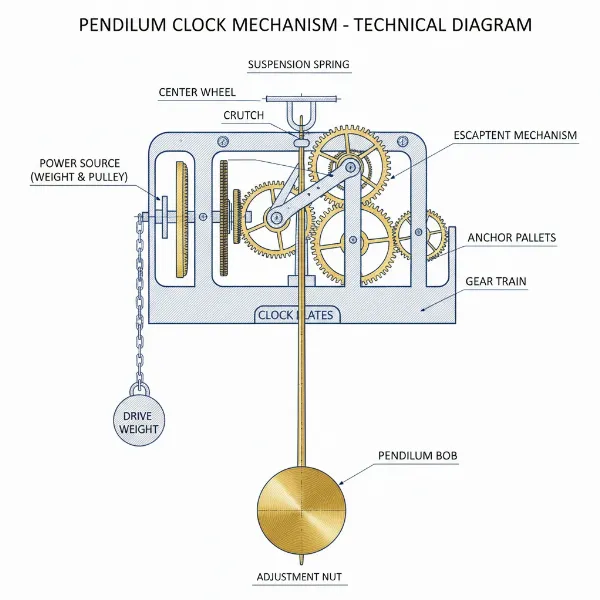 Diagram showing the internal mechanism of a pendulum clock with the pendulum bob highlighted.
Preparing for Adjustment
Before you begin any adjustments, preparation is key to ensuring accuracy and preventing potential damage.
- Gather Your Tools: The most crucial tool is an accurate reference time source, such as a smartphone, a digital clock, or an atomic clock. You will use this to compare against your pendulum clock’s time. A small notepad and pen can be helpful for tracking adjustments.
- Safety First: Always approach your clock with care. Gently stop the pendulum’s swing before making any physical adjustments to prevent stress on the delicate movement. Avoid forcing any components.
- Observe and Record Discrepancy: For precise regulation, you must know exactly how much time your clock is gaining or losing.
- Set your pendulum clock to the exact time using your reliable reference source.
- Allow the clock to run undisturbed for a full 24-hour period.
- After 24 hours, check your clock again against the reference time and note the exact difference (e.g., “5 minutes fast” or “3 minutes slow”). This daily rate of deviation will guide your adjustments.
Step-by-Step Pendulum Adjustment
The primary method for adjusting a pendulum clock’s speed involves altering the effective length of its pendulum. This is typically done via an adjustment nut located at the bottom of the pendulum bob.
- Locate the Adjustment Nut: On most pendulum clocks, including grandfather clocks and many wall clocks, you’ll find a small brass or metal nut directly beneath the large, heavy disk (the “bob”) of the pendulum.
- How to Speed Up Your Clock (If it’s Running Slow):
- If your clock is running slow, you need to shorten the pendulum’s effective length.
- Gently stop the pendulum.
- Turn the adjustment nut to the right (clockwise). This action will raise the pendulum bob slightly, shortening the pendulum.
- A helpful mnemonic is: “Right is faster, Raise to Race.”
- How to Slow Down Your Clock (If it’s Running Fast):
- If your clock is running fast, you need to lengthen the pendulum’s effective length.
- Gently stop the pendulum.
- Turn the adjustment nut to the left (counter-clockwise). This action will lower the pendulum bob slightly, lengthening the pendulum.
- Remember: “Left is slower, Lower to Linger.”
- Small Increments and Patience: Pendulum adjustment is a process of trial and error that requires patience. Even a single full turn (360 degrees) of the adjustment nut can change the clock’s speed by 1 to 2 minutes over a 24-hour period.
- Make a small adjustment (e.g., a quarter or half turn of the nut).
- Carefully restart the pendulum by gently pushing it to one side and releasing it.
- Reset the clock’s hands to the correct time.
- Allow the clock to run for another 24 hours and re-evaluate the time discrepancy.
- Repeat this process, making small, incremental adjustments until your clock keeps time accurately. It’s not uncommon for this regulation process to take several days or even a couple of weeks to achieve perfect accuracy.
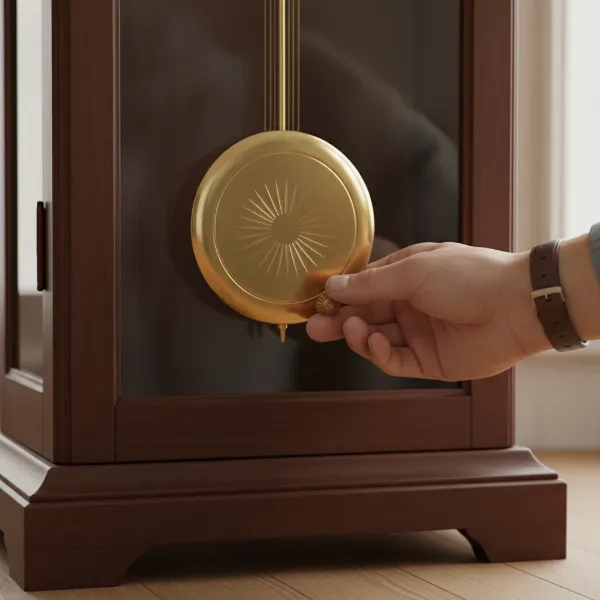 A person's hand carefully turning the adjustment nut at the bottom of a pendulum clock's bob.
Advanced Considerations & Troubleshooting
While adjusting the pendulum nut is the most common method, some clocks offer additional features or require attention to other factors.
- Clocks with a Rate Adjustment Arbor: Some mechanical clocks, particularly certain mantel clocks or older models, feature a fine adjustment arbor on the clock’s dial, often located at the 12 o’clock position and marked “S” (slow) and “F” (fast). This allows for minor adjustments without opening the clock or touching the pendulum directly. If your clock has this, use a double-ended key (the smaller end) to turn the arbor towards “F” to speed up the clock or “S” to slow it down.
- Environmental Factors: Pendulum clocks are sensitive to their surroundings. Significant temperature fluctuations can cause the pendulum rod to expand or contract, affecting its length and thus the clock’s speed. Ensure your clock is placed in a stable environment away from direct sunlight, heating vents, or drafty windows. Always ensure your clock is perfectly level; even a slight tilt can affect the pendulum’s swing and the clock’s accuracy.
- When to Seek Professional Help: If, after repeated careful adjustments, your clock still fails to keep accurate time, or if you notice any unusual noises, stopping, or inconsistent swinging, it might indicate a deeper mechanical issue. Problems such as friction in the gear train, a worn escapement, or improper lubrication require the expertise of a professional clock repair technician. Do not attempt to force internal mechanisms or dismantle the clock yourself if you are unsure, as this can cause irreversible damage.
Maintaining Your Clock’s Accuracy
Once you’ve successfully regulated your pendulum clock, consistent maintenance will help preserve its precision.
- Regular Checks: Periodically compare your clock’s time with a reliable source, especially after significant changes in temperature or if the clock has been moved.
- Proper Placement: Maintaining a stable, level position in a consistent environment is crucial for ongoing accuracy.
- Winding: If your clock is spring-driven, ensure it is fully wound at regular intervals as recommended by the manufacturer. A weakening mainspring can sometimes affect the clock’s rate, particularly towards the end of its winding cycle. Weight-driven clocks, generally, offer a more consistent power supply.
Conclusion
Adjusting the pendulum swing speed on your clock is a rewarding skill that connects you to the intricate mechanics of timekeeping. By understanding the principles of pendulum motion and applying patient, systematic adjustments, you can restore your cherished timepiece to its optimal accuracy. This process not only ensures your clock tells the correct time but also deepens your appreciation for the craftsmanship and engineering behind these elegant devices. With these guidelines, you’re well-equipped to maintain your clock’s precision and enjoy its timeless presence for years to come. What unique stories does your perfectly regulated pendulum clock tell in your home?
Frequently Asked Questions
How often should I adjust my pendulum clock?
|
Our Picks for the Best Wall clock in 2026
As an Amazon Associate I earn from qualifying purchases.
|
||
| Num | Product | Action |
|---|---|---|
| 1 | AKCISOT Wall Clock, Modern Small Wall Clocks Battery Operated 8 Inch, Silent Non-Ticking Analog Classic for Office, Home, Bathroom, Kitchen, Bedroom, School(Black) |

|
| 2 | AKCISOT Wall Clock, Modern Small Wall Clocks Battery Operated 8 Inch, Silent Non-Ticking Analog Classic for Office, Home, Bathroom, Kitchen, Bedroom, School(White) |
|
| 3 | WallarGe 14.5'' Large Digital Wall Clock Battery Operated with Jumbo Numbers, Temperature and Date - Easy to Read and Set, Auto DST |
|
| 4 | HIIXHC Wall Clock, Modern Digital Wall Clocks Battery Operated 10 Inch, Silent Non-Ticking Kitchen Clock, Small Classic Analog Clock Decorative for Living Room Decor, Bedroom,Office, Classroom |
|
| 5 | AKCISOT Atomic 10 Inch Wall Clock Analog Clocks for Indoor Kitchen, Battery Operated Clock for Bedroom Office Classroom Living Room(Silver) |
|
| 6 | AKCISOT Atomic 10 Inch Wall Clock Analog Clocks for Indoor Kitchen, Battery Operated Clock for Bedroom Office Classroom Living Room(Black) |
|
| 7 | AKCISOT Wall Clock 10 Inch Silent Non-Ticking Modern Clocks Battery Operated - Analog Small Classic for Office, Home, Bathroom, Kitchen, Bedroom, School, Living Room(Black) |
|
| 8 | AKCISOT Wall Clock,Boho Kitchen 10 Inch Wall Clocks Battery Operated Non Ticking,Silent Modern Clock Decorative for Bedroom,Office,Bathroom,Living Room,Home (Wood Grain) |
|
| 9 | AKCISOT Wall Clock, Modern Small Wall Clocks Battery Operated 8 Inch, Silent Non-Ticking Analog Classic for Office, Home, Bathroom, Kitchen, Bedroom, School(Silver) |
|
| 10 | AKCISOT Wall Clock 10 Inch Silent Wall Clocks Battery Operated Non Ticking - Modern Silver Clock Decorative for Kitchen, Bathroom, Bedroom, Living Room, Office, Home(Silver) |
|
Ideally, you should check your pendulum clock’s accuracy against a reliable source every few weeks or months. Major adjustments are typically only needed if you notice a significant drift in timekeeping, or if environmental factors like temperature or humidity change dramatically.
Can temperature affect my pendulum clock’s speed?
Yes, temperature can definitely affect your pendulum clock’s speed. Metal pendulum rods expand slightly when hot and contract when cold, changing their effective length. This can cause the clock to run slower in warmer conditions and faster in colder conditions.
What is the “bob” on a pendulum?
The “bob” refers to the heavy, disk-shaped weight at the bottom of the pendulum rod. Its position on the rod is crucial for regulating the clock’s speed, as it determines the pendulum’s effective length and thus its swing period.
How much does one turn of the nut change the time?
As a general rule of thumb, one complete 360-degree turn of the adjustment nut at the bottom of the pendulum can change the clock’s timekeeping by approximately 1 to 2 minutes over a 24-hour period. Always make small adjustments and observe the results.
When should I call a professional for clock repair?
You should call a professional clock repair technician if, after careful and repeated pendulum adjustments, your clock still doesn’t keep accurate time, or if it stops, makes unusual noises, or exhibits mechanical issues beyond simple regulation. They can diagnose internal problems like wear or lubrication needs.