Have you ever wondered if that vintage wall clock in your home is more than just a time-telling device? Perhaps it’s an heirloom, a flea market find, or a piece inherited through generations. While all wall clocks hold sentimental value, some possess a hidden worth that can surprise even seasoned collectors. Identifying a truly valuable vintage wall clock requires a keen eye, a bit of historical knowledge, and an understanding of what makes these mechanical marvels sought after. This comprehensive guide will equip you with the expertise to distinguish a decorative timepiece from a genuine horological treasure, helping you unlock the secrets of its true potential.
The Timeless Allure: A Brief History of Valuable Vintage Wall Clocks
The journey of the wall clock is a fascinating testament to human ingenuity and evolving aesthetics. From early weight-driven movements to intricate spring mechanisms, these timekeepers have graced public buildings and private residences for centuries. Understanding their historical context is the first step in recognizing potential value.
Early wall clocks, particularly from the 17th and 18th centuries, were often bespoke creations for the affluent, showcasing exceptional craftsmanship. The 19th century witnessed the rise of industrialization, leading to mass production and a broader accessibility of clocks. While this made clocks ubiquitous, it also created a distinct divide in value: those meticulously handmade by renowned artisans versus the more common factory-produced models. Key eras to focus on for valuable vintage wall clocks include the English Golden Age of horology (late 17th-18th century), the ornamental French period (18th-19th century), and specific periods of German precision and early American craftsmanship. These periods yielded iconic styles, innovative mechanisms, and the works of master clockmakers that remain highly prized today.
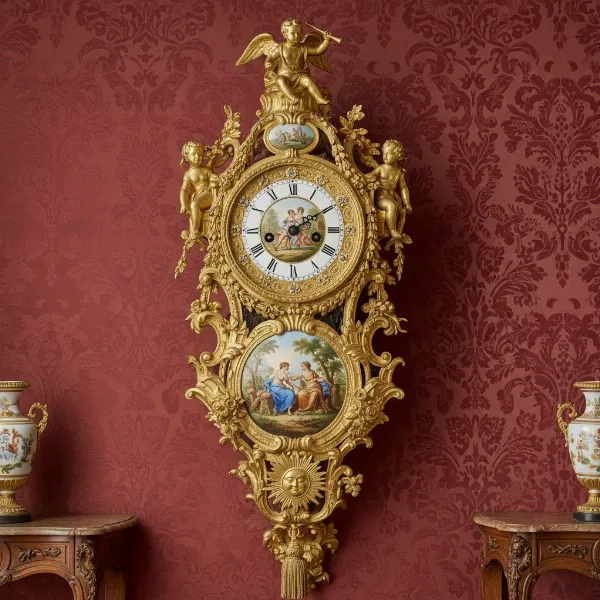 Intricately designed French vintage wall clock from the 18th century.
Beyond Decoration: Types of Valuable Vintage Wall Clocks
Not all vintage wall clocks are created equal in the eyes of collectors. Certain types, movements, and origins are inherently more valuable due to their historical significance, rarity, or mechanical sophistication.
- Regulator Clocks: Valued for their exceptional accuracy, true early 19th-century Vienna Regulators, for instance, are highly sought after. These precision instruments, often featuring long pendulums and simple, elegant designs, were originally used in scientific settings and railway stations.
- Banjo Clocks: A distinctly American innovation, especially original examples patented by Simon Willard in the early 1800s, are considered icons of American design and command significant prices. Their unique shape is instantly recognizable.
- Cuckoo Clocks: While many are mass-produced souvenirs, antique cuckoo clocks from Germany’s Black Forest region, especially those with intricate hand-carvings and complex automaton features dating back to the 18th or 19th century, can be quite valuable.
- Schoolhouse Clocks: These utilitarian pendulum-driven clocks, common in classrooms and offices, can hold value if they are early examples from reputable American makers like E. Howard & Co. or Seth Thomas, particularly specific “Regulator” models.
- Specialized European Clocks: Wall-mounted versions of bracket clocks, or certain French clocks with ornate gilt-bronze (ormolu) cases and porcelain panels, can also be highly valuable.
The value isn’t just in the style but often in the maker and the complexity hidden within its case.
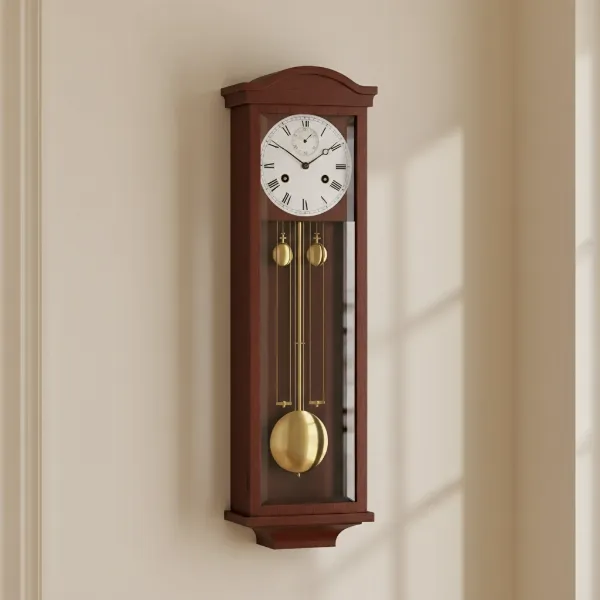 Elegant 19th-century Vienna Regulator wall clock with long pendulum.
The Anatomy of Value: Key Factors in Identifying a Valuable Vintage Wall Clock
To truly assess a vintage wall clock’s worth, you must look beyond its surface. Several critical factors contribute to its value, forming a hierarchy from authenticity to rarity.
Decoding the Craftsmanship: Materials and Construction
The quality of materials and the artistry of its construction are fundamental indicators of a clock’s pedigree.
- Premium Woods: Valuable vintage wall clocks often feature solid, high-quality hardwoods. Look for rich grains in mahogany, walnut, oak, cherry, or rosewood. The specific type of wood can also offer clues about its origin and period, helping confirm authenticity. The presence of plywood or particleboard, common in clocks made after 1905, is a clear sign it’s not a genuine antique.
- Fine Metals and Embellishments: Beyond wood, examine any metal components. Brass and bronze should exhibit a natural patina—a greenish or brownish tint—developed over decades. The use of ormolu (finely cast, gilded bronze) signifies a luxury piece, particularly in French clocks. Decorative elements like hand-painted porcelain panels from renowned makers such as Sèvres, Meissen, or Limoges, or sections of marble or enamel, are strong indicators of a high-value item.
- Glass and Dials: The glass should feel sturdy and show signs of age, perhaps with slight imperfections or cloudiness, rather than being perfectly clear like modern glass. The dial itself should be original to the clock, with any hand-painted numerals or decorations showing consistent aging.
|
Our Picks for the Best Wall clock in 2026
As an Amazon Associate I earn from qualifying purchases.
|
||
| Num | Product | Action |
|---|---|---|
| 1 | WallarGe 14.5'' Large Digital Wall Clock Battery Operated with Jumbo Numbers, Temperature and Date - Easy to Read and Set, Auto DST |

|
| 2 | HIIXHC Wall Clock, Modern Digital Wall Clocks Battery Operated 10 Inch, Silent Non-Ticking Kitchen Clock, Small Classic Analog Clock Decorative for Living Room Decor, Bedroom,Office, Classroom |
|
| 3 | AKCISOT Wall Clock, Modern Small Wall Clocks Battery Operated 8 Inch, Silent Non-Ticking Analog Classic for Office, Home, Bathroom, Kitchen, Bedroom, School(Silver) |
|
| 4 | AKCISOT Wall Clock, Modern Small Wall Clocks Battery Operated 8 Inch, Silent Non-Ticking Analog Classic for Office, Home, Bathroom, Kitchen, Bedroom, School(Black) |
|
| 5 | AKCISOT Atomic 10 Inch Wall Clock Analog Clocks for Indoor Kitchen, Battery Operated Clock for Bedroom Office Classroom Living Room(Black) |
|
| 6 | AKCISOT Wall Clock,Boho Kitchen 10 Inch Wall Clocks Battery Operated Non Ticking,Silent Modern Clock Decorative for Bedroom,Office,Bathroom,Living Room,Home (Wood Grain) |
|
| 7 | AKCISOT Atomic 10 Inch Wall Clock Analog Clocks for Indoor Kitchen, Battery Operated Clock for Bedroom Office Classroom Living Room(Silver) |
|
| 8 | AKCISOT Wall Clock, Modern Small Wall Clocks Battery Operated 8 Inch, Silent Non-Ticking Analog Classic for Office, Home, Bathroom, Kitchen, Bedroom, School(White) |
|
| 9 | AKCISOT Wall Clock 10 Inch Silent Wall Clocks Battery Operated Non Ticking - Modern Silver Clock Decorative for Kitchen, Bathroom, Bedroom, Living Room, Office, Home(Silver) |
|
| 10 | AKCISOT Wall Clock 10 Inch Silent Non-Ticking Modern Clocks Battery Operated - Analog Small Classic for Office, Home, Bathroom, Kitchen, Bedroom, School, Living Room(Black) |
|
“The material used in an antique clock’s case is often the first clue to its quality and potential value. Master clockmakers never skimped on materials.” – Delia, Mearto Specialist
The Heart of the Clock: Movement and Mechanism
The internal mechanism, or “movement,” is the engineering marvel that drives the clock and is a primary determinant of value.
- Types of Movements: The most valuable vintage wall clocks typically possess mechanical movements (weight-driven or spring-driven). Weight-driven mechanisms, often found in larger, more accurate timekeepers like regulators, tend to be more valuable than their spring-driven counterparts due to their associated precision. Quartz movements, powered by batteries, are modern inventions and indicate a clock of significantly lower vintage value.
- Complexity: Appraisers often look for the presence of “trains” within the movement. A one-train movement simply powers the time. A two-train movement also includes a striking mechanism (like striking a bell on the hour). A highly desirable three-train movement adds a chiming mechanism (playing melodies on the quarter-hour, such as Westminster chimes). The increased complexity signifies higher craftsmanship and rarity.
- Eight-Day vs. Daily Winders: Clocks designed to run for eight days on a single winding are generally more valuable than those requiring daily winding, reflecting a higher level of mechanical sophistication.
- Originality and Condition of Movement: The movement should be original to the clock and in excellent condition. Signs of excessive wear, crude repairs (like punch marks near pivot holes), or broken gear teeth can diminish value. An untouched, clean, and well-maintained movement is highly prized.
Unveiling Authenticity: Maker’s Marks and Provenance
These factors provide concrete evidence of a clock’s origins and history, significantly influencing its value.
- Identifying Trademarks and Signatures: A clockmaker’s mark is like a certificate of authenticity. Look for signatures, trademarks, or labels engraved or painted on the dial, stamped on the backplate of the movement, or printed on a paper label pasted inside the case or on the backboard. The presence of a recognized maker’s name (e.g., E. Howard, Seth Thomas, Gustav Becker) instantly elevates a clock’s desirability. Serial numbers can also be invaluable for dating a piece precisely.
- The Power of Provenance: A documented history of ownership, known as provenance, can dramatically increase a clock’s value. If a clock can be traced back to a notable collector, a historical event, or a prominent family, its story becomes part of its intrinsic worth. This “history of ownership” transforms a functional object into a historical artifact.
- Distinguishing Originals from Reproductions: Be vigilant for signs of fakery. Mismatched components (e.g., an 18th-century dial in a 19th-century case), incorrect materials (plywood, plastic), modern screws, or artificially aged labels are red flags. Scrutinize maker’s marks for misspellings or logos that don’t match documented examples.
Assessing Condition: The Key to Value
Condition is paramount. Even a clock from a prestigious maker will fetch less if it’s in poor shape.
- Overall Physical State: Inspect the entire clock. Look for chips, deep scratches, cracks, or missing sections of veneer or inlay on the case. The original finish, even with wear, is highly desirable as it contributes to the clock’s patina and historical appeal.
- Working Order: A clock that functions correctly is generally worth more than one that requires extensive repairs. While mechanical servicing is acceptable, major functional issues can significantly reduce value.
- The Dilemma of Restoration: This is a crucial point for collectors. Unrestored clocks with all original features (glass, finish, parts) in exceptional condition nearly always sell for higher prices. Over-restoration—such as aggressive polishing that removes patina, complete refinishing of a wooden case, or poorly repainting a dial—can strip away historical character and dramatically diminish value. Minimal, professional mechanical servicing to restore function is usually acceptable, but aesthetic “improvements” that erase history are detrimental.
Identifying Value: A Comparison of Key Vintage Wall Clock Attributes
To help visualize how different attributes impact a vintage wall clock’s value, consider the following comparison:
| Valuation Factor | Low Value Indicators | High Value Indicators | Impact on Value |
|---|---|---|---|
| Originality | Mixed parts, non-period replacements, reproductions | All original components (case, dial, movement, hands, glass) | Crucial: Authenticity is foundational to value. |
| Condition | Significant damage, poor repairs, over-restored | Excellent, untouched condition, original patina intact | Major: Pristine originals command top prices. |
| Maker’s Mark | Unmarked, attributed to, fake labels, misspelled names | Clear signature/trademark of a renowned clockmaker, serial numbers | Significant: Confirms authenticity, pedigree, and rarity. |
| Movement Complexity | Simple time-only (one-train), daily wind, quartz | Three-train (time, strike, chime), eight-day, weight-driven, complications | High: Reflects advanced craftsmanship and rarity. |
| Material Quality | Plywood, plastic, common veneers, cheap metals | Solid hardwoods (mahogany, walnut), ormolu, porcelain, marble, fine brass | Moderate to High: Indicates luxury and quality. |
| Provenance | Unknown history | Documented history from notable collections or figures | Exponential: Can multiply value significantly. |
| Rarity | Mass-produced, common styles | Limited production, unique designs, short-lived makers | Significant: Supply and demand dictate higher prices. |
Preserving Legacy: Care and Maintenance for Valuable Vintage Wall Clocks
Once you’ve identified a potentially valuable vintage wall clock, proper care and maintenance are essential to preserving its condition and value for future generations.
Antique clocks are delicate mechanical wonders that require a stable environment. Avoid placing your wall clock in direct sunlight, which can fade and damage the wood finish, or near sources of extreme heat or moisture like radiators, fireplaces, or damp walls. A stable temperature and humidity are ideal. For pendulum clocks, ensure the clock is perfectly level on a stable surface. This allows the pendulum to swing evenly, a critical factor for accurate timekeeping and for the clock to remain “in beat.”
Regarding maintenance, the intricate movement of an antique clock requires professional attention. It should be professionally cleaned and oiled every few years to prevent wear and ensure smooth operation. Attempting amateur repairs or over-oiling the mechanism can cause irreversible damage and significantly devalue the clock. When winding a spring-driven clock, turn the key or crank smoothly until you feel firm resistance, and never force it. When setting the time, always move the minute hand forward, pausing at the striking points to allow the clock to chime or strike completely. Avoid moving the hands backward unless the specific mechanism is known to allow it.
“Proper maintenance isn’t just about keeping the time; it’s about preserving the original integrity of the clock, which is crucial for its long-term value.” – Admin, wallclockus.com
Integrating History: Displaying Your Valuable Vintage Wall Clock
A valuable vintage wall clock isn’t just an investment; it’s a piece of art and history that deserves to be showcased. Integrating it thoughtfully into your home decor can highlight its beauty and value.
The best position for your wall clock should consider both aesthetics and preservation. Choose a prominent wall that can structurally support its weight and allows for easy viewing of its intricate details. Consider the clock’s style: a grand Vienna Regulator might be a striking focal point in a formal living room, while a charming Banjo clock could add historical character to a hallway. Contrast the clock’s historical style with modern elements for a sophisticated, eclectic look, or blend it seamlessly into a traditionally decorated space. Remember to ensure the location avoids direct sunlight and environmental extremes. Using appropriate lighting can emphasize the clock’s craftsmanship, patinas, and decorative embellishments, making it a true centerpiece of your decor.
Navigating the Market: A Buying Guide for Valuable Vintage Wall Clocks
For those looking to acquire a valuable vintage wall clock, navigating the market requires a strategic approach, encompassing preliminary research, professional appraisal, and an understanding of current trends.
Before making a purchase, conduct thorough preliminary research using the valuation factors discussed in this guide. Examine potential clocks for maker’s marks, assess their condition (both external and internal movement), and identify their style and potential period. Researching realized prices for similar clocks on auction house websites (Christie’s, Sotheby’s, Bonhams) or reputable online antique platforms can provide a valuable, albeit approximate, price range.
For a definitive and formal valuation, especially for a potentially high-value clock, consulting a professional, independent appraiser or a qualified horologist is essential. These experts possess the nuanced knowledge to identify subtle details, detect restorations or fakes, and provide a value based on current market conditions. Be cautious of appraisers who immediately offer to buy the item, as this can present a conflict of interest. Major auction houses often offer free online estimates, which can be a good starting point.
The market for antique clocks is currently bifurcated: a robust high-end market for rare, exceptional pieces by master makers, and a softer market for common, mid-range clocks. While masterpieces continue to achieve record prices, many common 19th-century factory-made clocks have seen declining values due to increased supply and shifting generational tastes. Some styles, like Art Deco and Mid-Century Modern clocks, are currently in higher demand for their decorative appeal. For a new collector, the prudent strategy is to “buy the best you can afford” – prioritizing excellent condition and originality from a reputable maker, even if lesser known, over acquiring several common clocks in poor condition.
Conclusion
Identifying a valuable vintage wall clock is a rewarding endeavor that combines historical appreciation with practical expertise. By meticulously examining its originality, condition, maker’s marks, movement complexity, material quality, and provenance, you can uncover hidden treasures that tell stories of bygone eras. While the market for antique clocks is dynamic, the enduring appeal of truly exceptional pieces ensures their place as both decorative assets and potential investments. Whether you’re a seasoned collector or a curious enthusiast, the journey of discovering and preserving these magnificent timepieces offers profound satisfaction. So, take a closer look at the wall clocks around you—what stories might they be waiting to tell?
Frequently Asked Questions
How can I tell if a vintage wall clock is authentic?
To determine authenticity, look for a clear maker’s mark or signature on the dial, movement, or case. Verify that all components (case, dial, movement) are consistent in style and period. Check for quality materials like solid hardwoods or fine metals, and inspect for signs of genuine aging rather than artificial wear. The presence of modern materials like plywood or plastic indicates a reproduction.
Which manufacturers are known for valuable vintage wall clocks?
Renowned manufacturers known for valuable vintage wall clocks include English masters like Thomas Tompion and George Graham, French geniuses such as Abraham-Louis Breguet, and American pioneers like Simon Willard (especially for Banjo clocks) and E. Howard & Co. (for precision regulators). German makers like Gustav Becker are also highly regarded for Vienna Regulators.
Does a non-working vintage wall clock have value?
A non-working vintage wall clock generally has less value than a functional one. However, if it’s from a prestigious maker, is exceptionally rare, possesses outstanding original condition (despite not running), or has significant historical provenance, it can still hold considerable value, particularly if the movement is complete and repairable by an expert.
Should I restore an old wall clock?
Restoration is a delicate process. Generally, minimal, professional mechanical servicing to ensure the clock runs is acceptable and can even increase value. However, extensive aesthetic “restoration” that alters the original patina, finish, or replaces original parts can significantly diminish a clock’s value. Unrestored clocks in excellent original condition are usually preferred by serious collectors.
Where are maker’s marks typically found on vintage clocks?
Maker’s marks, signatures, or trademarks can be found in several locations on a vintage wall clock. Common spots include engraved or painted on the clock’s face or dial, stamped or engraved on the backplate of the internal movement, or printed on a paper label pasted inside the clock’s case or on its backboard. Always check multiple locations.